
1. The Superstack Thesis
Crypto infrastructure today is deeply fragmented across virtual machines, isolated liquidity pools, and complex developer toolchains. At the same time, the next wave of users will not be humans manually configuring gas fees and signing hexadecimal hashes on browser extensions. They will be autonomous on-chain AI agents running inside self-sovereign devices.
To support this shift, the industry requires three distinct, cooperative layers of infrastructure working together as a single unified system:
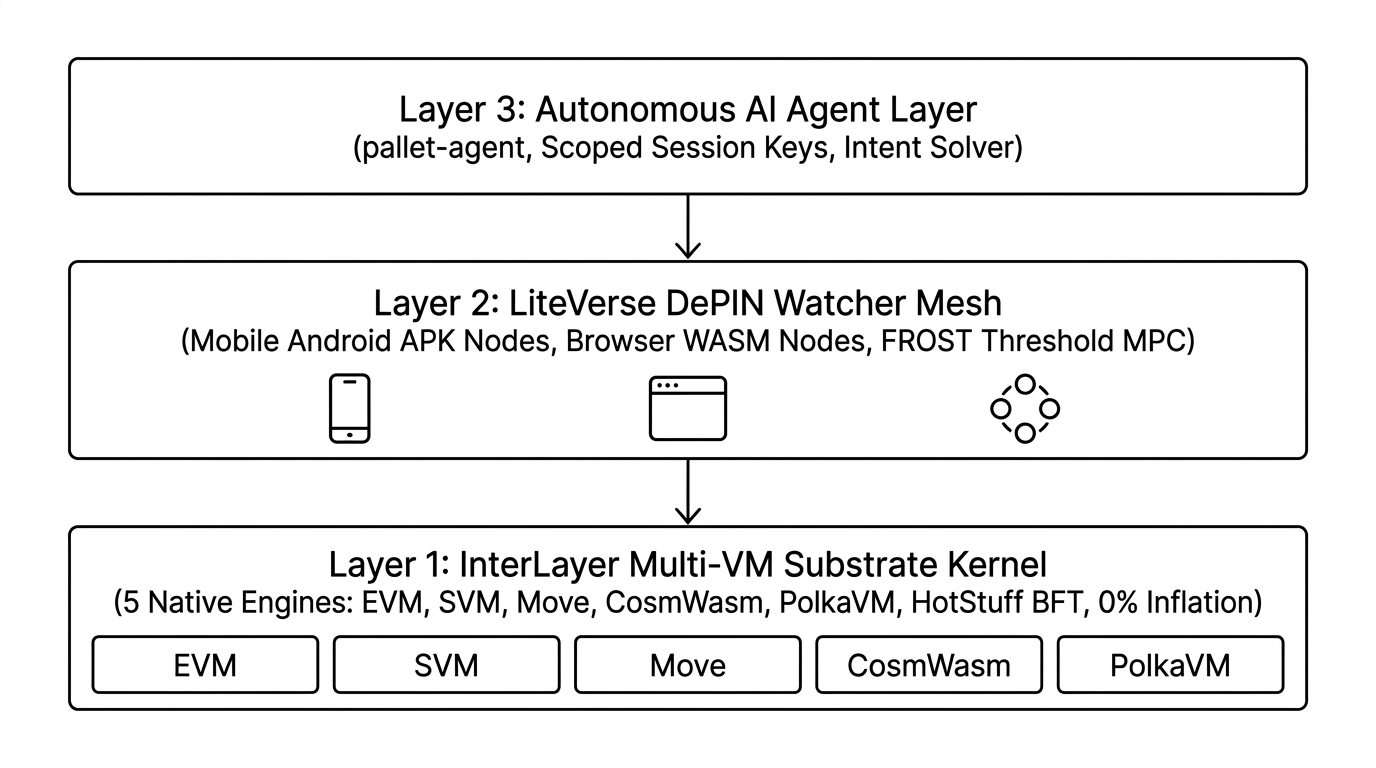
2. Layer 1: InterLayer Multi-VM Substrate Kernel (L1)
At the base of the superstack is the InterLayer Multi-VM Substrate Kernel: a sovereign Layer-1 execution engine designed to eliminate language and liquidity fragmentation.
Core Capabilities:
- 7 Native VM Engines: Runs EVM (
revm), SVM (solana_rbpf), Move (move-vm-runtime), CosmWasm (wasmi), PolkaVM (RISC-V), Cairo STARK ZK (cairo-vm), and Candle AI (candle-core) side-by-side inside a single Substrate runtime. - Unified Account Balance: All virtual machines access a single global native balance, eliminating synthetic wrapped tokens.
- Atomic Cross-VM Rollbacks: If an operation across multiple virtual machines encounters an error, the entire transaction reverts atomically with zero partial execution state corruption.
- Pipelined 3-Chain HotStuff BFT: Sub-500ms block production with BLS12-381 aggregate signatures for instant, deterministic finality.
- 0.0% Annual Inflation: Real-yield tokenomics where 100% of network rewards originate from actual Multi-VM transaction fees.
3. Layer 2: LiteVerse DePIN Watcher Mesh
The middle layer of the stack is LiteVerse: a decentralized physical infrastructure network (DePIN) composed of lightweight client-side compute nodes.
Core Capabilities:
- Zero-Overhead Client Nodes: Runs natively as an Android mobile APK and inside web browser tabs (
browser.liteverse.network), turning consumer hardware into verification nodes. - Shadow Bridge Monitoring: LiteVerse nodes continuously watch external blockchains (Bitcoin, Ethereum, Solana) and submit cryptographic deposit witnesses on-chain.
- Incentive Alignment: LiteVerse node operators earn 10% of total network fees and witness bounties for verified deposit attestations.
- Threshold MPC Custody: Coordinates with a 5-node FROST MPC cluster to manage unique, personal derived deposit addresses without communal bridge contract honeypots.
4. Layer 3: InterClaw Autonomous AI Agent Layer
The top layer of the superstack is InterClaw: an on-chain autonomous assistant built for the Web3 Smartphone era.
Core Capabilities:
- Scoped Session Keys (
pallet-agent): Users delegate restricted execution keys with strict daily gas budgets, contract whitelists, and automatic expiration, ensuring master private keys are never exposed to cloud servers. - Natural Language Intent Compilation: Translates high-level user prompts ("Arbitrage 1 ETH across EVM Uniswap and SVM Raydium") into synchronous atomic Multi-VM bundles.
- Web3 Smartphone Operating Companion: Integrates with local hardware security modules (HSM / StrongBox) to manage decentralized identity, trading automation, and treasury operations autonomously.
5. Summary: The Complete Superstack
By uniting the sovereign Multi-VM L1 Kernel, the LiteVerse DePIN Watcher Mesh, and the InterClaw AI Agent Layer, the InterLayer Superstack establishes a self-sovereign, multi-chain computing foundation engineered specifically for the autonomous Web3 era.