
1. Why the Wrapped Token Model is Fundamentally Broken
Cross-chain bridges have suffered over $3.5 Billion in cumulative exploits. The fundamental flaw lies in the Lock & Mint Wrapped Token Architecture: locking physical collateral in a single smart contract pool guarded by a static multisig to mint synthetic IOU tokens on another chain.
When a bridge contract bugs or multisig keys are compromised, the entire pool is drained, leaving users holding unbacked, worthless IOUs.
2. The InterLayer Architecture: CEX-Style Onboarding with Decentralized Verification
InterLayer eliminates communal contract vaults entirely. Every user receives unique, deterministic deposit addresses across external chains such as Bitcoin, Ethereum, Solana, and custom UTXO/EVM networks:
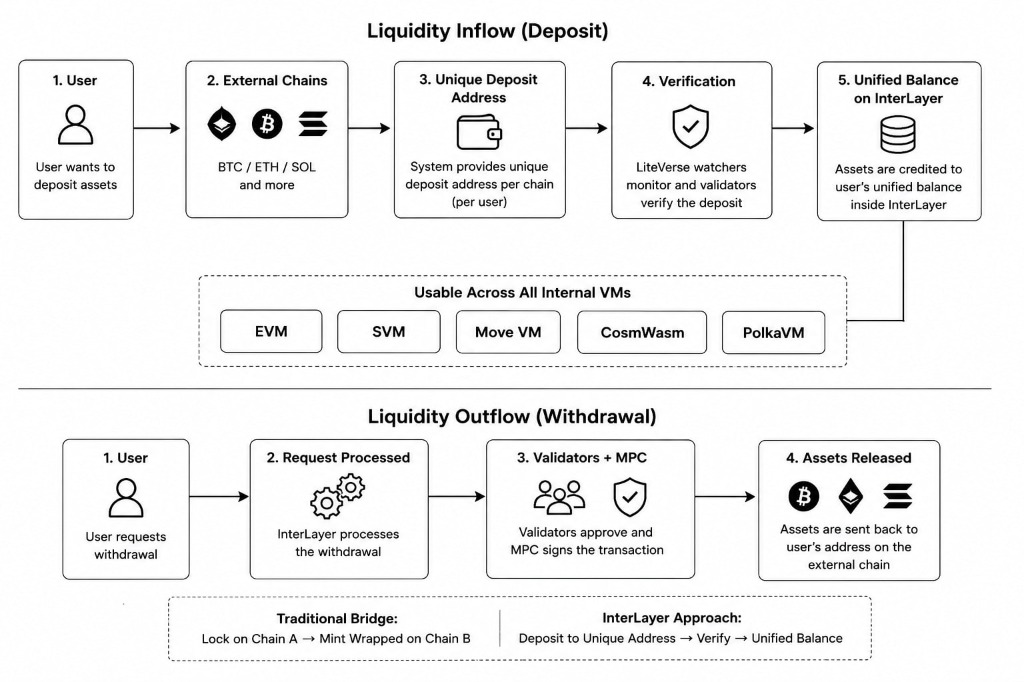
Liquidity Inflow (Deposit Flow):
- User Request: User deposits real native assets (BTC, ETH, SOL) into their personal derived deposit address (
alice@btc,alice@eth). - LiteVerse Watcher Monitoring: Distributed light clients running on Android smartphones and web browser tabs monitor block headers.
- Validator Witness Attestation: Validators verify the deposit on-chain once confirmation depth is reached.
- Unified Native Balance Crediting: Assets are credited directly to the user's Unified Balance inside InterLayer, usable immediately across all 7 virtual machines (EVM, SVM, PolkaVM, Move, CosmWasm, Cairo VM, Candle AI).
Liquidity Outflow (Withdrawal Flow):
- User Withdrawal Request: User requests asset release on the external chain.
- Consensus Validation: InterLayer consensus verifies account balance and burns the internal credit.
- Threshold MPC Co-Signing: A 5-node FROST MPC cluster where any 3 nodes cooperatively sign co-authorizes the transaction without reconstructing the master private key in memory.
- Batched Asset Release: Up to 50 user withdrawals are bundled into a single batch, reducing external network gas overhead by 90% to 99%.
3. From Simple Deposits to Programmable Multichain Accounts
A critical advantage of this architecture is that these multichain addresses are not limited to simple deposits and withdrawals:
"Since these addresses are tied directly to a user's InterLayer identity, they become fully programmable accounts. User-authorized AI agents can interact with external chains, trade on external DEXs, manage treasury operations, execute payments, and automate cross-chain workflows while operating within strict, user-defined safety policies."
Programmable Capabilities:
- Autonomous Cross-Chain Treasury Management: Authorized agents rebalance liquidity across Bitcoin, Ethereum, and Solana automatically.
- Scoped Permission Keys (
pallet-agent): Users set daily spending limits and contract whitelists, preventing runaway losses even if an AI agent malfunctions. - Zero Master Private Key Exposure: The user never exports or exposes their raw private keys to cloud servers.
4. The LiteVerse DePIN Watcher Mesh & Incentive Alignment
External chain monitoring is backed by LiteVerse: a decentralized physical infrastructure network (DePIN) of mobile Android nodes and browser WASM light clients:
- Lightweight SPV Sync: Mobile nodes sync block headers with negligible battery and data usage.
- Watcher Rewards: To incentivize decentralized participation, LiteVerse watcher nodes receive 10% of total network fees and witness bounties for every deposit witness they successfully submit on-chain.
- Tiered Reserve Safety: 5% of liquid capital is maintained in an automated hot pool for instant sub-second withdrawals, while 95% remains secured in the MPC-governed sub-treasury.
Zero wrapped tokens. Zero communal bridge honeypots. 100% mathematical custody.